

Hamburger Buttonclosesearch
العربيةkeyboard_arrow_right

Decarbonizing Our Operations

We are already among the lowest carbon intensity oil and gas producers in the world, built on decades of investment in operational excellence, energy efficiency and reduction of methane emissions.

Decarbonization is a long-term journey, and we are approaching it in stages. This lets us act on the opportunities available today while we deliver the larger, more complex projects that take longer to build. At each stage, we prioritize our actions by cost, readiness and scale to keep making measurable progress.

We started our journey with focused improvements across our existing operations, including greater energy efficiency and reduced methane and leaks. We are now delivering our larger projects, including electrifying our facilities at scale and capturing carbon from our hardest-to-abate sources. In the meantime, we have started to build decarbonization into how we design our assets, source our power and grow our business. This phased approach is helping us achieve our near-term target of a 25% reduction in the carbon intensity of our operations by 2030, a key step toward our Net Zero by 2045 ambition.
Increasing energy efficiency

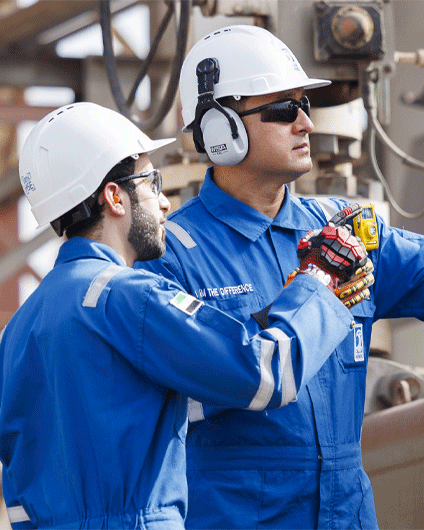
Energy efficiency is one of the most effective ways we reduce emissions. Using less energy lowers our emissions, cuts costs and makes our operations more resilient. We focus on three areas: optimizing our processes, integrating our energy systems and deploying new technology. Together, these improve how our assets perform, increase output and reduce the energy each barrel requires. 

Our Shah Oil Field is a clear example. It has reached a carbon intensity of 0.1 kg CO₂e/boe, one of the lowest of any oil field in the world, and a benchmark for the industry. 

Electrifying our operations

A large share of the energy our facilities use has traditionally come from burning gas and diesel on site. By powering them with electricity instead, we cut these emissions at the source.

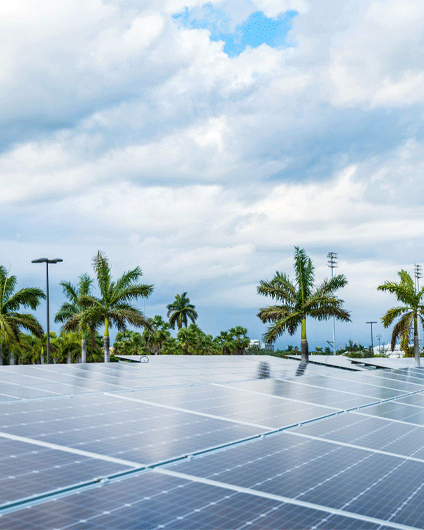
In 2022, we became the world's first major oil and gas company to power all of our onshore operations with grid electricity from solar and nuclear sources, through TAQA's power network.

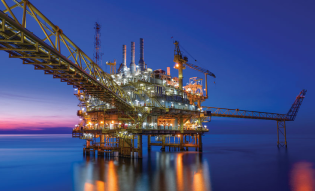
We are now building the region's first sub-sea transmission network, which will replace offshore gas turbines with solar and nuclear power. This $3.8 billion network will supply electricity to our offshore operations. By the end of 2025, we had laid around 950 km of subsea cabling and completed key island connections and electrical infrastructure. Once finished, the project is expected to cut at least 5 million tonnes of CO₂e emissions each year, an important step toward our 2030 carbon intensity target.


Driving down methane emissions

Methane is a powerful greenhouse gas, with a far greater warming effect than carbon dioxide. Reducing it is one of the most effective ways to cut our emissions, which is why we have set a goal to reach near-zero methane emissions by 2030.

To find and fix methane leaks, we are testing and rolling out the latest detection technologies, including satellite imaging, aerial drones and robotic inspectors fitted with advanced sensors. We are also working to eliminate routine flaring across our operations which are helping the UAE maintain one of the lowest flaring volumes and intensities among oil and gas producers.

To reduce methane, we first need to measure it accurately. Rather than rely on broad estimates, as the industry once did, we measure our methane directly at our sites. This shows us where it comes from, so we can target the biggest sources. We report this data through the Oil and Gas Methane Partnership (OGMP) 2.0, the United Nations' leading methane reporting standard. Our reporting earned the OGMP 2.0 Gold Standard, the highest level, for 2024 and 2025, giving confidence that our figures are accurate and independently verified.


Expanding carbon capture

Carbon Capture, Utilization and Storage (CCUS) helps lower the carbon intensity of our own operations and supports other hard-to-abate industries in reducing their emissions.

Our flagship CCUS facility, Al Reyadah, was the first commercial-scale project of its kind in the Middle East and has a carbon capture capacity of 800,000 tonnes of CO₂ a year from Emirates Steel.

In 2023, we took final investment decisions on two major projects, Habshan CCUS and Hail and Ghasha. Together, they will raise our carbon capture capacity to 4 million tonnes a year. Both are in construction, with Habshan due to start up in 2026 and Hail and Ghasha by 2028.

We are also developing the capacity to store CO₂ underground. Using 3D seismic surveys and geological modelling, we assess sites across Abu Dhabi to find those most suitable for safe, long-term storage. We have already seen our first results: CO₂ from Fertiglobe's UAE operations is now stored in onshore saline aquifers, supporting the production of certified low-carbon ammonia.